

Large tortoiseshell
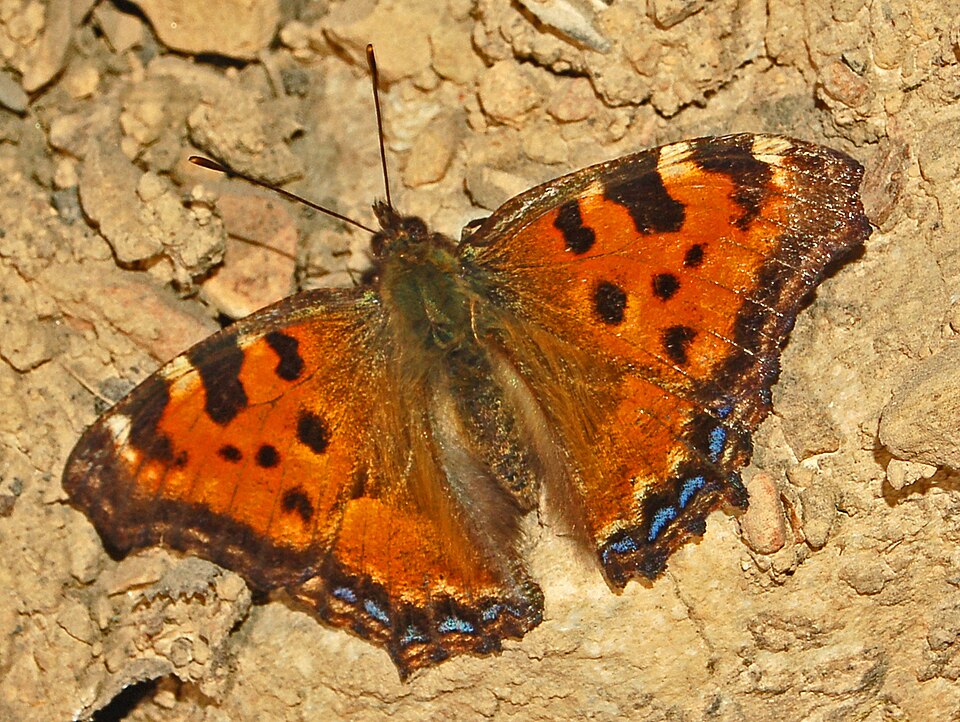
The large tortoiseshell is a big orange butterfly with black and yellow patches and small blue spots along the edges of its back wings. Underneath, its wings are smoky brown, so it can hide on tree bark. It sleeps through the whole winter as a butterfly.
How big is it?
How wide are its wings?
How big is Large tortoiseshell compared to YOU?
Just maths in your browser. Nothing is saved or sent anywhere.
How fast is it?
Fun facts
It spends the winter hiding in hollow trees or sheds and wakes up in late February or March.
The female lays her eggs in a ring all the way around a thin twig.
The caterpillars live together and strip the top twigs of a tree bare.
It disappeared from Britain for many years but is now coming back, and could become Britain's 60th home butterfly.
The best way to tell it from the small tortoiseshell is its dark hairy legs.
Most asked questions about Large tortoiseshell
?How big is the large tortoiseshell?
Its wings are about 7 cm across.
?What does the large tortoiseshell eat?
The butterflies drink tree sap and juice from overripe fruit. The caterpillars eat leaves of elm, willow and other trees.
?Where does the large tortoiseshell spend the winter?
As a butterfly, sleeping in hollow trees or sheds.
For bug experts
- Scientific name
- Nymphalis polychloros
- Group
- Butterflies
- Family
- Nymphalidae
- Classification
- Insecta > Lepidoptera > Nymphalidae
- Lives on
- Europe, Africa, Asia
- Also known as
- Blackleg tortoiseshell
Where the facts come from
- Large tortoiseshell (Wikipedia, CC BY-SA 4.0): what it looks like, where it lives, what it eats, sizes and fun facts, retold in simple words.
- Picture by Hectonichus. CC BY-SA 4.0, Wikimedia Commons. The round sticker of this bug is cut from the same picture.
If we got something wrong, sorry, we are bug fans, not a science journal. Tell us at hello@bugwiki.app and we will fix it.
 Monarch butterfly
 Peacock butterfly
 Blue morpho
 Old World swallowtail
 Small white
 Eastern tiger swallowtail
 Red triangle slug
 Spanish moon moth
 Spined micrathena
 Goliath stick insect
 Black and gold flat millipede
 Golden stag beetle