

Narcissus bulb fly
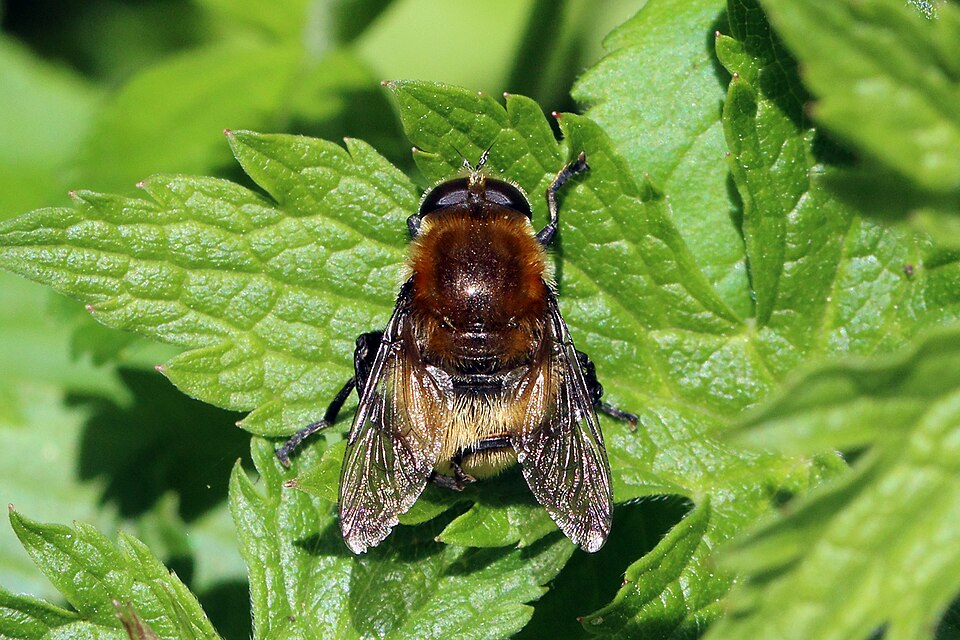
The narcissus bulb fly is a fat, very hairy hoverfly that looks just like a bumblebee. Looking like a bee that can sting helps keep its enemies away. It zigzags fast and low over the ground in spring.
How big is it?
How long is it?
How big is Narcissus bulb fly compared to YOU?
Just maths in your browser. Nothing is saved or sent anywhere.
How fast is it?
Fun facts
Its back legs have very thick thighs with a pointy bump underneath.
The mother lays her eggs one at a time on daffodil leaves or in the soil next to them.
Its larvae spend the winter inside the bulbs.
It often lands on bare ground between low plants.
Its hair can be many different colours, so not all of them look the same.
Most asked questions about Narcissus bulb fly
?Can the narcissus bulb fly sting?
No. It is a fly that only looks like a bumblebee, and flies cannot sting.
?Why are my daffodils not growing?
One reason can be the narcissus bulb fly. Its larvae live inside the bulbs and eat them.
?When does the narcissus bulb fly fly?
From April to July, low over the ground.
Myth buster
Myth: It is a bumblebee.
Truth: No. It is a hoverfly dressed up like a bumblebee. It has no sting at all.
For bug experts
- Scientific name
- Merodon equestris
- Group
- Flies and mosquitoes
- Family
- Syrphidae
- Classification
- Insecta > Diptera > Syrphidae
- Lives on
- Europe, Asia, North America, Australia and Oceania
- Also known as
- Greater bulb fly, Large bulb fly, Large narcissus fly
Where the facts come from
- Merodon equestris (Wikipedia, CC BY-SA 4.0): what it looks like, where it lives, what it eats, sizes and fun facts, retold in simple words.
- Picture by Charles J. Sharp. CC BY-SA 4.0, Wikimedia Commons. The round sticker of this bug is cut from the same picture.
If we got something wrong, sorry, we are bug fans, not a science journal. Tell us at hello@bugwiki.app and we will fix it.
 Housefly
 New World screwworm fly
 Lovebug
 Tsetse fly
 Common fruit fly
 Asian tiger mosquito
 Woolly apple aphid
 White garden snail
 Tawny mining bee
 Spurge hawk-moth
 Striped lynx spider
 Pea aphid
_grooming.jpg)