

Bug card No. 0154 of 1,500
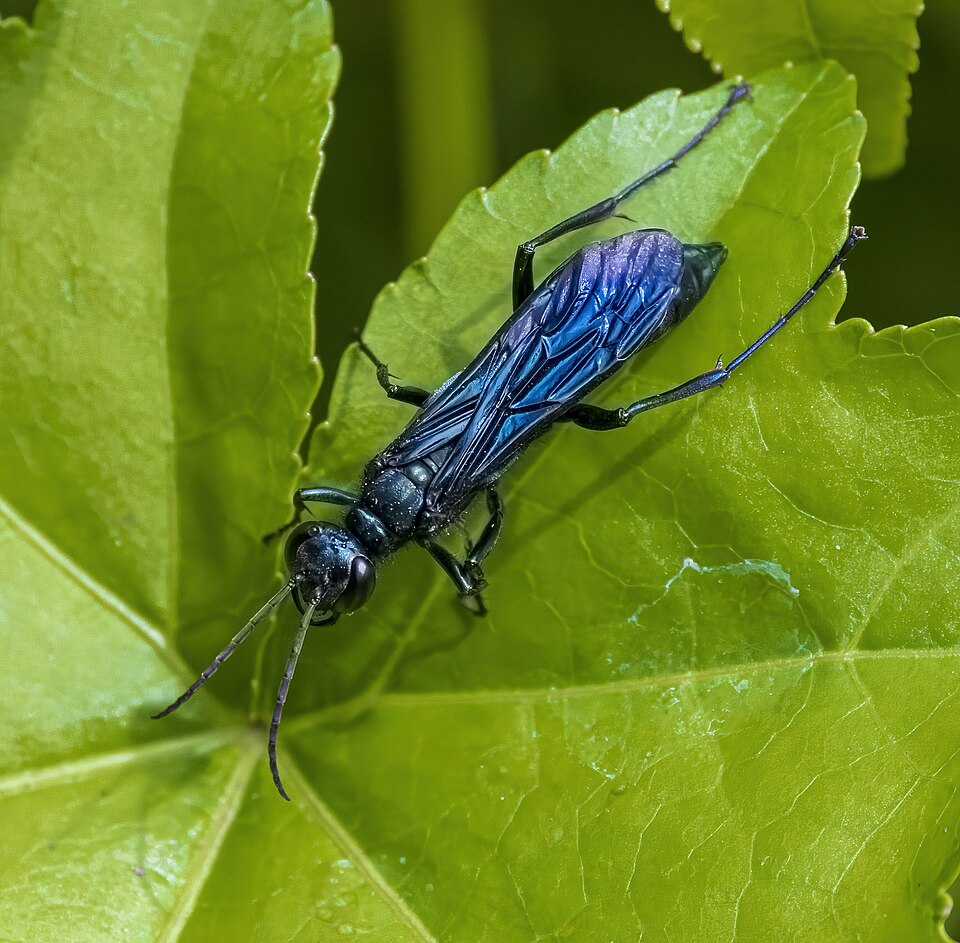
Blue mud dauber
Chalybion californicum
The blue mud dauber is a wasp that shines metallic blue, like a little flying jewel. It is famous for hunting spiders, even black widows. It is a calm wasp that usually leaves people alone.
Lives in
From northern Mexico to southern Canada. People also brought it to Hawaii and parts of Europe
What does it eat?
The grown-up wasps drink nectar from flowers to power their flying. Their babies are fed with spiders that the mother catches.
How fast is it?
A kid running fast about 13 km/h (8.1 mph)
Blue mud dauber about 22 km/h (14 mph)
A grown-up on a bike about 25 km/h (16 mph)
A car driving in town about 50 km/h (31 mph)
cool stuff
Fun facts
1
It is best known for catching black widow spiders to feed its babies.
2
Instead of building a new nest, the mother often moves into an old mud nest of another wasp. She throws out the old spiders and fills it with fresh ones for her own egg.
3
While it drinks nectar, it helps pollinate wildflowers such as wild carrot.
you asked
Most asked questions about Blue mud dauber
?What does the blue mud dauber eat?
Grown-ups drink flower nectar. The babies eat spiders, often black widows, that the mother brings them.
For bug experts
- Scientific name
- Chalybion californicum
- Named by
- Saussure, 1867
- Group
- Wasps and hornets
- Family
- Sphecidae
- Classification
- Insecta > Hymenoptera > Sphecidae
- Lives on
- North America, Europe, Australia and Oceania
- Also known as
- Common blue mud-dauber wasp, Nearctic blue mud-dauber
Where the facts come from
- Chalybion californicum (Wikipedia, CC BY-SA 4.0): what it looks like, where it lives, what it eats, sizes and fun facts, retold in simple words.
- Picture by (c) Nell Cant, some rights reserved (CC BY). CC BY 4.0, Wikimedia Commons. The round sticker of this bug is cut from the same picture.
If we got something wrong, sorry, we are bug fans, not a science journal. Tell us at hello@bugwiki.app and we will fix it.
 European hornet
 Northern giant hornet
 Bald-faced hornet
 Red velvet ant
 Eastern cicada killer
 Asian hornet
 Cotton aphid
 Green hairstreak
 Grapeleaf skeletoniser
 Goldenrod gall fly
 Greenhouse whitefly
 Red slug