

Mexican grass-carrying wasp
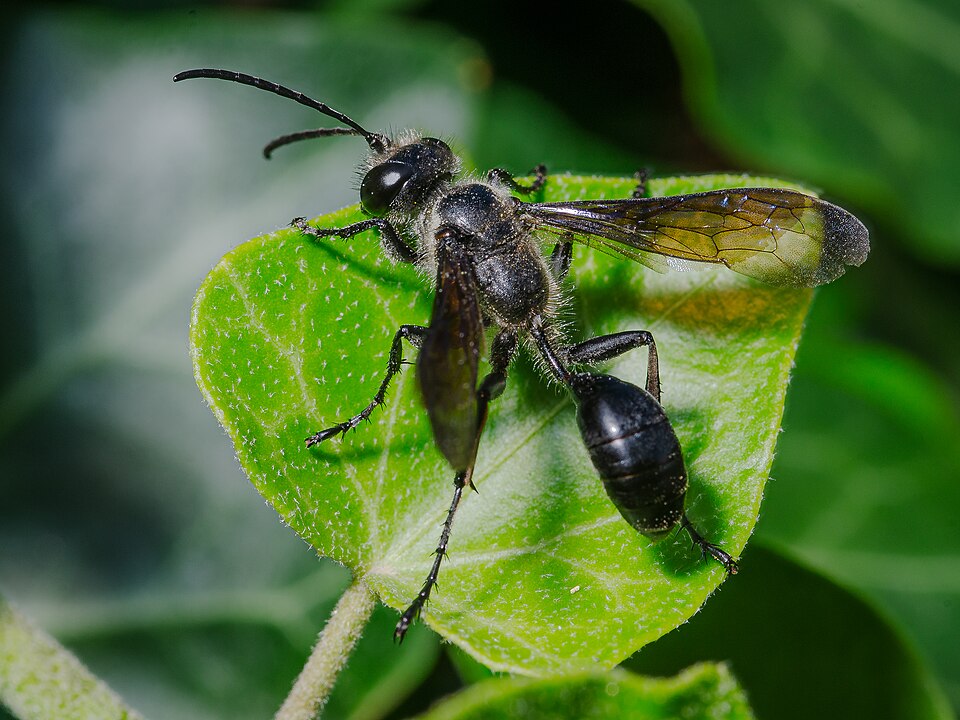
The Mexican grass-carrying wasp is an all-black wasp with a hairy chest and smoky brown wings. It got its name because it carries bits of grass to line its nest. It builds its home inside hollow branches and other little holes.
How big is it?
How long is it?
How big is Mexican grass-carrying wasp compared to YOU?
Just maths in your browser. Nothing is saved or sent anywhere.
How fast is it?
Fun facts
It often moves into old nests that other insects built.
It came to Europe by accident from North America and is slowly spreading there.
The females are bigger than the males and come out later in the summer.
You can see it from early summer until September.
Most asked questions about Mexican grass-carrying wasp
?Why is it called grass-carrying wasp?
Because it carries pieces of grass and plant fibres into its nest to line it.
?What does a grass-carrying wasp eat?
The mother hunts small katydids and tree crickets as food for her young.
For bug experts
- Scientific name
- Isodontia mexicana
- Group
- Wasps and hornets
- Family
- Sphecidae
- Classification
- Insecta > Hymenoptera > Sphecidae
- Lives on
- North America, Europe
Where the facts come from
- Isodontia mexicana (Wikipedia, CC BY-SA 4.0): what it looks like, where it lives, what it eats, sizes and fun facts, retold in simple words.
- Picture by pjt56. CC BY-SA 3.0, Wikimedia Commons. The round sticker of this bug is cut from the same picture.
If we got something wrong, sorry, we are bug fans, not a science journal. Tell us at hello@bugwiki.app and we will fix it.
 European hornet
 Northern giant hornet
 Bald-faced hornet
 Red velvet ant
 Eastern cicada killer
 Asian hornet
 Orchard spider
 Evergreen bagworm
 Picasso bug
 Emperor moth
 Ailanthus webworm
 Salt marsh moth